
Find Carlsbad Residents by Starting Point
No single master list answers every question. A Carlsbad residents directory works instead as a route through several custodians, and the starting fact decides the first stop. A current address points to the county assessor and its GIS map. A name can lead to recorded documents, court parties, a business filing, or a professional license. Family-history questions belong at the Georgina Cole Library. Directories, newspapers, census databases, microform, photographs, and research help sit under that one roof. Every result needs a date and a source. An owner, a voter, a former occupant, and a party in a filing are not interchangeable people. Start with the narrowest fact in hand. Keep the physical parcel separate from its mailing destination. Treat a court case as a party record, never as proof of where someone lives now. A directory is a dated snapshot, nothing more. When a record is not online, the road still runs through a kiosk, a mailed copy request, an in-person file, a library appointment, or a focused California Public Records Act request.
- Start with the county property-information search or a GIS map when an address is known. Save the APN, situs wording, subdivision, and map context.
- Use the current owner channel by telephone or office kiosk, since the public web tools do not offer a general owner-name search.
- Search the Recorder's Official Records Index by party name, date, document number, or other known detail, then separate the free index from the document image.
- Use the San Diego court index, vital-record rules, business filings, or license searches only for the question each source can answer.
- Move older or missing material to the Cole Library, court microfilm, county archives, a mailed request, or a city records request with a clear record description.
Street-by-street searching needs more room. The Carlsbad street directory walks the full address chain in detail. A one-person question fits the Carlsbad resident lookup workflow, where name variants and identity checks get closer attention.
Where Carlsbad Resident Records Live
Carlsbad is an incorporated North County coastal city, not the San Diego County seat. That fact shapes any residents directory search. City Hall holds municipal permits, planning files, police records, contracts, agendas, and administrative writings. County offices keep the core trails: property, deeds, marriages, fictitious business names, courts, and elections. The library adds the lived-community layer that official indexes rarely preserve. The office split is practical. One department, the County Assessor/Recorder/County Clerk, combines property and recorded-document functions. The Registrar of Voters controls election data and a self-check tool. The Superior Court index points to the facility holding a case. The City Clerk handles focused municipal requests under the California Public Records Act. A good request names an existing record, a date range, a department, an address, a project number, or a case identifier, rather than asking an agency to build a new list.
San Diego County Recorder / Clerk
Recorder mail: P.O. Box 121750
San Diego, CA 92112-1750
619-238-8158
San Diego County Assessor
Public Information Line
Ownership by phone or kiosk
619-236-3771
San Diego County Registrar
5600 Overland Avenue
San Diego, CA 92123
858-565-5800
Recorder copies come by mail or through the county's copy and kiosk channels. City inspection is ordinarily free. Direct duplication and special electronic extraction can carry costs. Those access differences matter when a Carlsbad records search starts online but ends at a counter.
Carlsbad Property Search Starts with the Parcel
Begin with the parcel. The county property-information system and ParcelQuest work best from a parcel number or street address. Online results can show the APN, situs address, map, and characteristics. They can also show assessed land and improvement values, sales or transfer references, and exemption details. Ownership is public record. Still, San Diego County routes general owner-name questions to the phone line or an office kiosk. It does not offer a broad web-name directory. The tax mailing address is a delivery destination. It is not proof the owner lives at the parcel. GIS adds a geographic check. The City GIS applications and the County Integrated Spatial Information System map draw parcel lines. They also add layers for public property, facilities, land use, districts, and planning context. A map links a street to APNs and nearby lots. It is reference data, though, not a boundary survey. Save the exact APN before moving on to the Recorder.
| Property search field | What to enter or expect |
|---|---|
| Parcel number | Use the APN as the stable county map-book identifier. |
| Property address | Search the situs address and normalize unit numbers and street directions. |
| Assessment year | Use the current assessment or Notification of Assessed Value search when available. |
| Map search | Move through parcel pages and map navigation to inspect neighboring lots. |
| Owner name | Ask the Assessor by telephone or use an office kiosk; it is not a general web-name mode. |
A building record can name an owner, applicant, architect, and contractor. It may also list the permit number, scope, and issue or final date. That dates construction or alteration, but it never proves who occupied the property. When a permit packet is not online, the City of Carlsbad public-record request channel is the proper fallback. That channel serves as the proper fallback.
The Carlsbad Deed Index Has a 1970 Boundary
The San Diego County Official Records Index runs from 1970 to the present. Its free result is an index, not an open image. Party names, recording dates, document numbers, document types, and older book/page references are all searchable. An indexed instrument may show parties. It may show an instrument number, a type, and a date. Sometimes it shows an APN. A purchased copy can add the grantor and grantee. It can also add the legal description, return address, transfer-tax clues, signatures, and the recording stamp. Not every instrument carries every name or APN. AB 1785 changed the address workflow on December 9, 2024. APN search left the public web index but survives at five county office kiosks. So an address researcher takes a first step. That step is crossing the address to an APN in property information or GIS. The current owner then serves as a grantee search term online. When the APN itself is the bridge, the kiosk takes over. Pre-1970 deeds live in office kiosks, grantor-grantee books, microfilm, or the County Archives. Recorder staff will explain the request route. They will not turn the index into a complete resident list.
- Party or name
- Search grantor and grantee spellings, trusts, entities, and variants in the free index.
- Recording date
- Narrow a common name around a transfer or lien by using a date range.
- Document number
- Retrieve a known recorded instrument directly from the index.
- APN
- Bridge a parcel to instruments at a county kiosk after the web search change.
- Image or copy
- Read the legal instrument and certify it when needed through a paid copy, kiosk, or mail request.
Copies from the recorder run $2 for the first page. Each added page costs five cents, and certification adds a dollar per document. Card payments carry a $2.50 surcharge. Check the current fee page before ordering anything. The Owner Alert service watches up to ten names and ten APNs for prospective notices, though its message delivers only an index link and document number, never the document contents.
San Diego Court Cases for a Carlsbad Name
A Carlsbad name in the San Diego Superior Court Online Case Search is a party clue. It is not a residence finding. The index spans Civil, Criminal, Family, Mental Health, and Probate records. A hit can return the case title, number, facility, case type, filing date, and parties. Juvenile and traffic matters sit outside it. Anything filed before 1974 does too. Older civil or misdemeanor material may live on microfilm at court locations. Staff will not run open-ended microfilm research for you, though.
The Register of Actions can add event dates, document titles, hearings, and judicial officers. It can also add a flag showing a document can be purchased. Still, a linked entry does not make the pleading remotely public. Sealed, confidential, adoption, juvenile, sensitive, and fee-waiver records stay restricted. Order copies through the facility named in the result. You can go in person, by mail, or through its ordering channel. Probate can tie a decedent to a representative, heirs, and property. Any old allegation or address still deserves independent checking, but.
The San Diego Superior Court case-search resource lays out what a public index can and cannot expose.
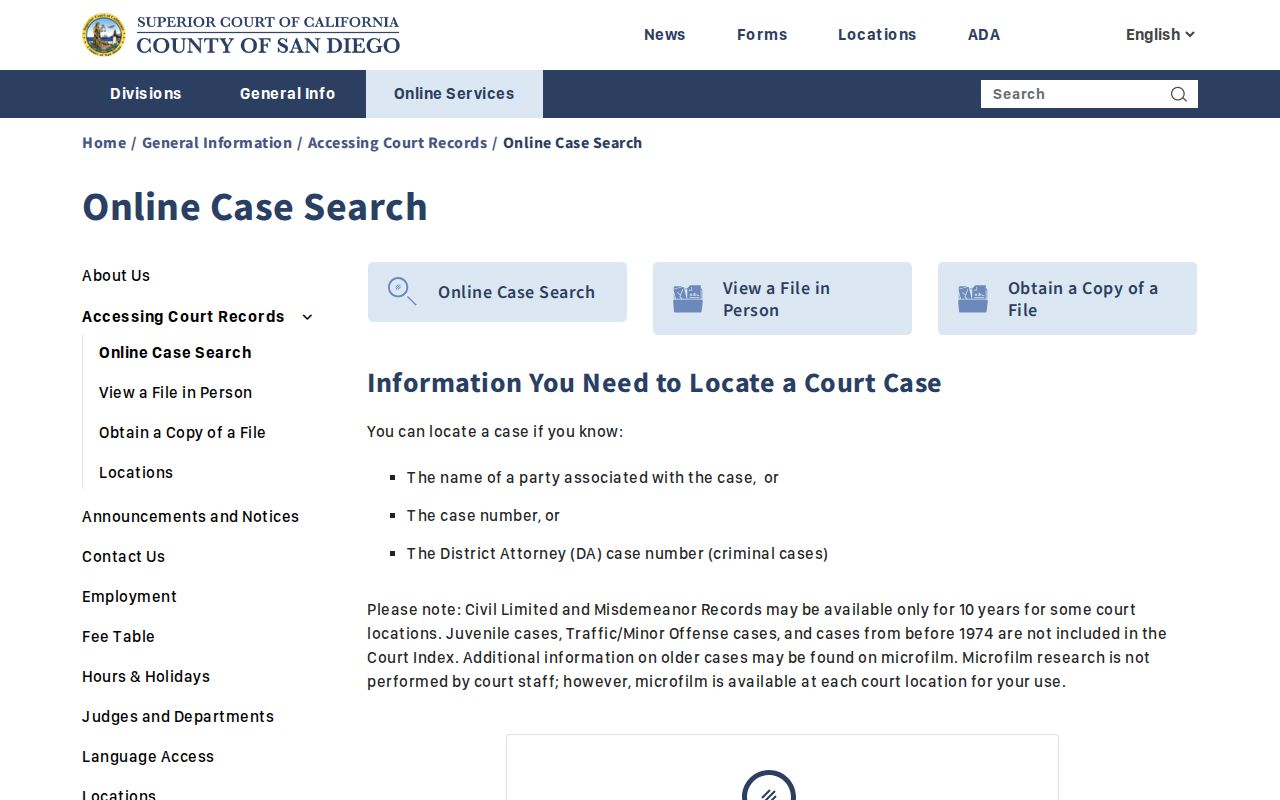
The court screen works best beside an APN, a date, a spouse, a business, or some other independent anchor. A shared name alone should never merge two Carlsbad records into one.
California Voter Lookup Needs Your Address
The San Diego County voter lookup exists so a voter can verify their own registration. It wants a house number, birth date, street name, street type, ZIP Code, and optional directionals. Mismatches happen for many reasons. A different address or a wrong birth date can break a match. So can a move out of the county. Processing lag can too. Missing license, state-ID, or last-four-SSN digits can all break a match as well. This is not a public name search. It cannot browse everyone on a Carlsbad street.
Each field in the self-check form serves a distinct purpose:
- House number: the numeric part of the registered residence.
- Birth date: a credential that must match the county registration record.
- Street components: name, type, and optional pre-direction or post-direction in separate fields.
- ZIP Code: the five-digit registered ZIP used with the other credentials.
- Party preference: a displayed preference choice, not a ballot choice.
Voter information in the full form goes only to election, scholarly, journalistic, political, or governmental uses. That limit sits in Elections Code §§2187(g) and 2194. Regulations appear in California Code of Regulations, title 2, §§19001–19013. A state file can cover up to ten specific voters. The fee runs $30 per record, capped at $100. Released participation history shows election type, date, and method. It never shows the ballot chosen.
Call the Registrar at 858-565-5800 or write rovmail@sdcounty.ca.gov with questions. Headquarters hours are 8–5, Monday through Friday. Registration status asserts a registration fact, not real-time presence, and protected addresses may be withheld.
Current Carlsbad Residents Directory Sources
Current directory-like sources overlap without ever listing the same people. The assessment roll is parcel-centered. The Recorder is instrument-centered, tracking parties to deeds and filings. The voter tool confirms one registrant's own record. A city permit names the participants in a project. Business or license files show a public affiliation. A community organization may publish an officer or contact route. A private member roster stays in house.
| Source | What it lists | Keeper | Best access route |
|---|---|---|---|
| Property information | APN, parcel, situs, owner channel, values, characteristics | County Assessor | Web, telephone, or kiosk |
| Official Records Index | Parties to deeds, liens, reconveyances, and maps | County Recorder | Free index, copy, kiosk, or mail |
| Voter self-lookup | One voter's registration status and address match | Registrar of Voters | Address, birth date, and ZIP |
| City files | Permit, planning, contract, and request participants | City of Carlsbad | Portal or focused CPRA request |
| Business and license files | Entity agents, license status, and public filing addresses | California agencies | Free online searches |
| Library collections | Past households, notices, photographs, and local associations | Georgina Cole Library | In person, databases, or appointment |
A Carlsbad residents directory search is strongest when each result carries its source's scope. A parcel owner is not every occupant. A court party is not necessarily a resident. A business agent may hide behind a commercial address. Every directory entry is really a dated survey, and those labels guard the search against false certainty.
California Vital Records Have Two Copy Types
Birth, death, and marriage records can confirm a family event. But California applies no single closure period to ordinary certificates. Health and Safety Code §§103525–103526 govern authorized certified copies. These go to listed relatives, representatives, court-authorized people, and official duties. A mailed authorized request needs the application plus a notarized sworn statement. Other requesters can generally get an informational copy stamped invalid for establishing identity. Confidential marriage certificates go only to spouses or a court-authorized requester under Family Code §511. Adoption and original birth records follow separate sealed-record rules.
- Birth certificate: $31 through the 2026 CDPH fee schedule.
- Death certificate: $26 through the 2026 CDPH fee schedule.
- Public marriage certificate: $19 through the 2026 CDPH fee schedule.
- Confidential marriage certificate: $19 where the state fee applies, with access limited to spouses or a court order.
- Dissolution certificate: $18; the decree itself remains with Superior Court.
CDPH takes checks or money orders by mail. When a search comes up empty, it can issue a Certificate of No Public Record, and the search fee is retained under Health and Safety Code §103650. For historical work, library databases, California indexes, obituaries, cemetery material, and archives can yield a lead without replacing the official certificate. Settle the record type and your relationship before sending any copy request.
Carlsbad History Lives on the Cole Library Mezzanine
The Genealogy and Carlsbad History Division sits at the Georgina Cole Library. It gives the Carlsbad residents directory its most distinctive local layer. You will find it at 1250 Carlsbad Village Drive. Newspapers, yearbooks, scrapbooks, letters, memorabilia, photographs, and microform all sit together on the mezzanine. Scanners, research guides, and fourteen genealogy databases round out the room. Six dedicated computers handle database work. Staff offer general help. The “Ask a Genealogist” service books a one-hour appointment for deeper questions.
Ancestry Library Edition, American Ancestors, Findmypast, and FamilySearch Affiliate access are onsite only. Cardholders get more from home. America’s Historical Newspapers, America’s News, Archives Unbound, Fold3, HeritageHub, HeritageQuest, and Newspapers.com Library Edition are all remote options. Each adds something different. Fold3 covers military and naturalization material. HeritageQuest holds census and genealogy books. HeritageHub reaches obituaries and death notices back to 1704. Access rules vary by database and location. Check the library's genealogy and local-history page before you go.
The North San Diego County Genealogical Society has partnered with the library for over fifty years. It hosts more than fifty free programs annually. For a specific city directory, search the catalog by exact title or year. Then ask the division to confirm the shelf or microform run. The public page publishes no exhaustive publisher list for Carlsbad or Oceanside. It lists no reverse-directory range and no last printed year. That gap stays open on purpose. A careful search reports only what is known.
Carlsbad's Historical Residents Directory Trail
Older Carlsbad resident directories sit on a wider North County and San Diego County shelf. A typical entry may list a surname, given name or initial, and a spouse in parentheses. It may also show an occupation, employer or workplace, home address, and telephone number. Some publishers added a homeowner or renter mark. A criss-cross section reverses the order. It runs by street name. Numbers ascend, followed by occupant or telephone, and sometimes "vacant" or a business. The abbreviation key changes by volume. Photograph it before transcription.
The older Village, Barrio, and Olde Carlsbad areas are more likely to yield deep directory, newspaper, photograph, and permit trails. La Costa, Aviara, Calavera Hills, Rancho Carrillo, and Bressi Ranch tend to begin in later subdivision and permit eras. County deeds and court records predate the city's 1952 incorporation. City planning and permit files become more useful after incorporation. Directory collections, entry fields, and household tracing belong with the library catalog and staff desk, not the current roll.
- Roll
- A government-held list or register, such as an assessment roll or voter file, with its own access rule.
- Index
- A pointer to a record, often showing names and dates without the full image or legal text.
- Parcel
- A mapped unit of land tied to an APN, which may contain one address, several units, or more than one structure.
- Criss-cross directory
- An address-ordered section that helps move from a street number to a listed household, not a complete census.
Verify One Carlsbad Name Across Sources
Matching names is the hardest part of any resident lookup. Begin with exact and variant spellings. Add a middle initial, a prior surname, an entity or trust name, and a tight date range. Demand two independent points before merging records. The same APN or legal description works. So does a spouse or relative, an occupation or license, an age band, or a consistent filing address. A name-only hit is just a lead. That court file, deed, obituary, or business record still needs a second point. It is not an identity.
| Official record trail | Commercial people-finder category |
|---|---|
| Named custodian | May combine purchased and inferred data from many sources. |
| Defined field and date | Freshness and matching rules vary across providers. |
| Copy or correction route | Removal may not change the government record or other copies. |
| Scope stated by the office | Household links can confuse owners, occupants, and unrelated people. |
Some searches need a different door. A birth-parent or adoption question goes through California's official adoption-information and court or social-services channels. Original birth records stay sealed. For an heir, probate petitions and orders can name a representative or devisee. Access rules still apply. For a former classmate, try yearbooks, newspapers, and library databases first. Each path keeps a Carlsbad residents directory search anchored to a real question.
Protected Addresses Create Intentional Gaps
California Safe at Home serves qualifying victims and survivors. It also covers certain reproductive-health workers. Each participant gets a substitute mailing address plus confidential voter registration. Government Code §§6205–6211 and §6209.5 also permit substitute addressing on specified real-property documents. The program cannot erase older public material. Judges, peace officers, and other protected groups follow separate redaction rules. DMV personal information stays closed under the Driver's Privacy Protection Act. Utility customer accounts are not a directory fallback either.
Honor these gaps rather than filling them by inference. A blank address might mean a protected voter. It might be a trust, a business filing, or a sealed case. It could also reflect an old index limitation. When a record is simply wrong, use the custodian's correction or request channel. For title monitoring, the county's free Owner Alert enrollment beats repeated searches. It tracks up to ten names and ten APNs per email. It also flags later indexed activity.
Lawful use. Carlsbad public records support family history, civic research, reconnection, and personal safety awareness. Do not use an address or name trail to stalk, harass, threaten, impersonate, or harm another person.
Public access is not unlimited use. California Penal Code §§646.9, 422, and 653.2 cover stalking, threats, and certain electronic harassment, while Code of Civil Procedure §527.6 offers a civil-harassment order process. A focused search that respects a custodian's limits serves accuracy and protects everyone named in the records.